


Dietitian roles are not just about nutrition advice—they are regulated decision-making positions that directly affect medical, public health, and performance outcomes.
Problem: Most people think dietitians “suggest diets.”
Agitation: That misunderstanding leads to career confusion, unsafe advice, and undervaluing trained professionals.
Solution: This guide breaks dietitian roles by authority, accountability, and real-world impact—not vague task lists.
Direct answer: Dietitians assess, diagnose, and manage nutrition-related conditions across healthcare, public health, sports, and industry—often with legal responsibility for outcomes.
Table of Contents
Key Takeaways
- Dietitians are regulated healthcare professionals in many countries
- Authority varies sharply by role and region
- Clinical roles carry legal liability
- Salary follows responsibility, not popularity
- Specialization matters more than general experience
What Is a Dietitian?
A dietitian is a formally trained nutrition professional authorized to deliver medical nutrition therapy and population-level interventions under national regulatory frameworks.
Unlike general nutrition advisors, dietitians:
- Work with diagnosed conditions
- Follow clinical guidelines
- Are legally accountable for outcomes
Standards are influenced by bodies such as the Academy of Nutrition and Dietetics and the World Health Organization.
Core Dietitian Roles by Sector
Clinical & Hospital Dietitians
Authority level: High
Where they work: Hospitals, ICUs, specialty clinics
Responsibilities
- Nutrition diagnosis
- Tube feeding & parenteral nutrition
- Disease-specific protocols
Example scenario
A renal dietitian adjusts electrolyte intake for dialysis patients—mistakes have immediate clinical consequences.
Community & Public Health Dietitians
Authority level: Medium–High
Responsibilities
- Maternal nutrition programs
- School meal planning
- Government health initiatives
Often aligned with frameworks from the National Health Service.
Sports & Performance Dietitians
Authority level: Medium
Responsibilities
- Athlete fueling
- Recovery strategies
- Supplement compliance
Key risk: Anti-doping violations.
Corporate, Food Industry & Media
Authority level: Low–Medium
Responsibilities
- Labeling compliance
- Product nutrition claims
- Consumer education
Dietitian vs Nutritionist (Critical Comparison)
| Factor | Dietitian | Nutritionist |
|---|---|---|
| Regulation | Government-regulated | Often unregulated |
| Clinical authority | Yes | Usually no |
| Can treat disease | Yes | No (in most countries) |
| Legal liability | High | Low |
| Required degree | Accredited | Varies |
Bottom line: Confusing these roles can cause legal and health risks.
Country-Wise Comparison (5 Countries)
| Country | Regulation | Years to Qualify | Avg Annual Pay* |
|---|---|---|---|
| USA | Strict | 4–6 | $60k–$85k |
| UK | Strict | 4–5 | £35k–£50k |
| Canada | Strict | 4–6 | CAD 65k–90k |
| Australia | Strict | 4–5 | AUD 65k–95k |
| India | Moderate | 3–5 | ₹3–8 LPA |
Career Path & Specialization ROI
Progression
- Entry dietitian
- Senior specialist
- Consultant / policy advisor
High-ROI specializations
- Renal nutrition
- Oncology nutrition
- Sports performance
- Public health policy
Dos & Don’ts (Real Advice)
Do
- Verify accreditation before enrolling
- Choose specialization early
- Understand local regulation
Don’t
- Assume social media nutrition = dietetics
- Ignore liability exposure
- Expect fast income without credentials
Tools, Skills & Technology Stack
- Nutrition analysis software
- Electronic medical records
- Research literacy
Coding check: AI tools assist analysis—but cannot replace clinical judgment.
Dietitian’s Apparel and Equipment
When she consults in her office or on an outdoor mission, she works in street clothes. Hospital dietitians may also work in instream clothing, but in theory, they should wear at least white cotton to avoid the transfer of bacteria.
To carry out his consultation he mainly needs small measuring instruments. Will need: a scale to monitor your client’s weight, a skinfold message to calculate the percentage of body fat percentage and a metrete to measure waist circumference. When it sets up on its own, it should equip its premises: waiting room, office, computer, etc.
Essential Qualities Required to Become a Dietitian
- A dietitian should have a solid knowledge of nutrition to give proper and effective recommendations, especially while dealing with sick patients.
- She also knows other wellness techniques (psychology, physical exercise, relaxation) to help her patient find holistic balance.
- Because it is difficult to change one’s habits, the dietitian must be patient, educational, and empathetic to facilitate and accompany these changes as much as possible.
- More generally his interpersonal skills and friendliness help him help a real bond with his client, which is essential to the success of their collaboration.
- Friendship helps him form a real bond with his customer, which is essential to the success of their collaboration.
Opportunities, Recruitment, was to Work as Dietitian
- Most dietitians work in a health facility (hospital, nursing home, rehabilitation center, etc.). In this case, they are civil servants, and schools (in the canteen) And can also practice in the sports centers of the state.
- Some dietitians work as freelancers at home or in the office. With this position, they can also undertake external missions as a consultant or coach to high-level athletes or luxury hotels.
- A dietitian may also be employed in a thalassotherapy center, within a sports federation, or in a private mass
Schedules of Dietitians’ Conditions and Working
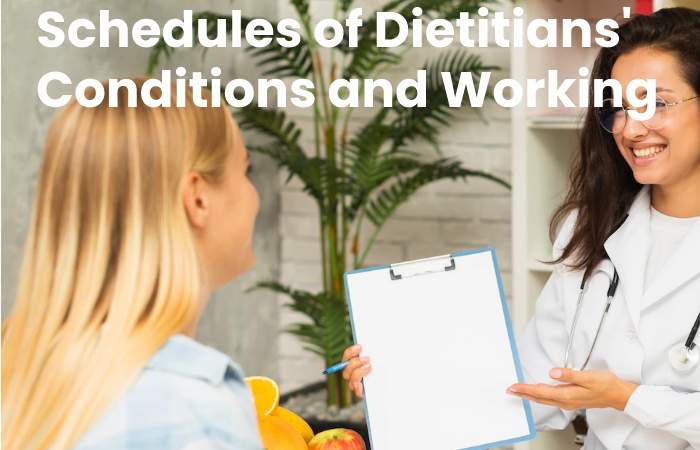
Hours: In hospitals, hours vary greatly. Unlike medical staff, a dietitian does not need to be present-day and night, as she does not deal with emergencies. But she sometimes works long hours, as she may be responsible for following up on multiple patients, conducting outpatient consultations, and overseeing a catering service.
As a Freelancer, at Home or in the Office, Dietitians Your Program is free to choose from, but she usually consults 5 days a week. Including Saturdays so that it adapts to the needs of its customers. She may decide to consult only 1 or 2 days a week and work in a hospital environment for the rest of the time. In the private sector (spas, hotels) their hours are regular.
Working conditions in a hospital are sometimes stressful. As the pace is fast and you have to deal with sick people throughout the day. The situation is better when dieticians are self-employed or are employed in the private sector.
Conclusion
The dietitian advises the patients and defines with them the eating behavior adapted to their problems. His mission can vary slightly depending on where he works: hospitals, clinics, care establishments, private practices, EPHAD (welcome dependent elderly people), school groups, etc.
FAQs
1. Are dietitians doctors?
No. They are allied health professionals with specialized nutrition authority.
2. Can dietitians prescribe medication?
No, but they prescribe nutrition therapies that directly affect treatment.
3. Is dietitian a good career long-term?
Yes, especially with specialization and clinical experience.
4. What’s the biggest risk in this career?
High responsibility and regulatory compliance.
5. Can dietitians work online?
Yes, but clinical roles often require licensure jurisdictionally.
6. Dietitian vs nutritionist—which pays more?
Dietitians, due to regulation and accountability.
7. Is this career future-proof?
Yes—chronic disease and aging populations increase demand.